Killing Shalom


I believe sin is the willful disregard for the things of God. It includes the intentional denial of God’s existence, the intentional disobedience to the commandments of God, pride, and placing anything above God (such as self, money, family, fame, status, etc.) As we explored last week, sin actually originated in Heaven. What’s more, we are all sinners but Jesus is our antidote to sin:

For there is no difference; for all have sinned and fall short of the glory of God, being justified freely by His grace through the redemption that is in Christ Jesus, whom God set forth as a propitiation [atonement, payment] by His blood, through faith. (Romans 3:22-25, NKJV).

But how else can we define sin?  Plantinga states that, “in short, sin is culpable shalom-breaking”[1]. Additionally he states that “sin is blamable vandalism” against God’s design of shalom and is thereby “an affront to their architect and builder”[2]. These quotes help me begin to ponder a wider definition of sin, but they are incomplete without Plantinga’s definition of shalom which “means universal flourishing, wholeness, and delight—a rich state of affairs in which natural needs are satisfied and natural gifts naturally employed”[3] (emphasis in the original). Sin, as Plantinga presents it, is a willful or intentional thought or act that somehow disrupts someone’s or something’s flourishing. This is somewhat of a flimsy summary without a concrete, though somewhat minor, example.
Trash_pic

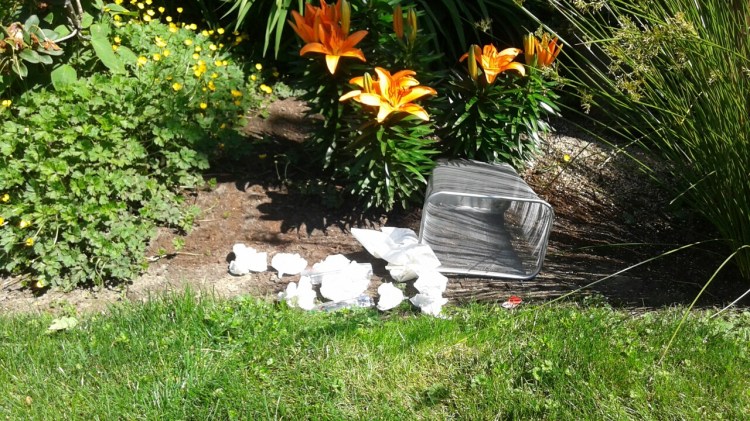
This is a simple illustration of something we have all seen, and quite possibly have done: litter. If I litter, something like throwing trash onto a beautiful landscape, I’ve now willfully disturbed nature by introducing a man-made artifact into the natural beauty. I have littered; I have juxtaposed God’s creative beauty with my personal refuse. I have opened the door to an animal or bird mistakenly eating a littered item and possibly getting sick or dying because of it. I have also marred the aesthetic beauty of the area, thus diminishing another person’s joy of what could have otherwise been a peaceful spot of solitude and praise toward God.

I have disrupted the shalom of an otherwise pristine beauty. This blemish now retards the flourishing of both the natural realm and the relationship to other humans because they now to have to endure this blemish. This other person may be the one to fix the blemish in an attempt to restore the area to its near natural state. How do they do this? By picking up the ugly trash I left behind. Once they pick it up, they have to properly dispose of it. This person is now not only enduring the blemish, but is now having their time impacted due to fixing someone else’s vandalism.

I realize this example does not rise to the same level as adultery or murder, but it is a subtle and important, though not readily recognizable, example of shalom disturbance. It illustrates the tarnished interior of the functional aspect of the image of God discussed last week. It is the insidious nature of sin working in simple areas of our lives where we willfully disturb shalom. As this willfulness grows, it expands into greater expressions of shalom-disturbing acts. So take this simple example of littering into other areas where we begin willfully harming humanity.  If littering is shalom disturbance, thus sin; then how much more of a “shalom disturbance” are the easier to recognize sins such as lying, rape and murder?

But lest we lose hope, this flawed aspect of our image of God can begin to be rehabilitated through Jesus Christ:

“Behold! The Lamb of God who takes away the sin of the world!” (John 1:29.)

Christ died for our sins. (1 Corinthians 15:3.)

“Repent, and let every one of you be baptized in the name of Jesus Christ for the remission of sins; and you shall receive the gift of the Holy Spirit.” (Acts 2:38.)

[1] Cornelius Plantinga, Jr Cornelius Plantinga, Jr., Not the Way it’s Supposed to Be: A breviary of sin (Grand Rapids: Wm. B. Eerdmans Publishing Co., 1995), p. 13.

[2] Ibid., p. 16.

[3] Ibid., p. 10.


Image

Image_2

What is my image? Is it what I portray on social media via my computer? Is it what the mirror reflects? Is it what other’s think of me? Hmmm.


In God’s Image

Scripture states that God created humanity “in His own image” (Genesis 1:27; see also Genesis 9:6 and James 3:9). But what does this mean?

When I was a freshman at the great institution of conservatism known as the University of Oregon, I thought that maybe the image started as an ape, thinking I could marry creation and evolution. It didn’t take too long to realize this was wrong-headed. But I still had no answer.

Erickson states that “the biblical picture of humanity’s origin is that an all-wise, all-powerful, and good God created the human race to love and serve him, and to enjoy a relationship with him” (Christian Theology, 2013, p. 439). I don’t dispute this, but I’m still unsure about the image of God in humanity.


Two Aspects

Anthony Hoekema concludes that God’s image in humanity has two aspects: what humanity is and what humanity does. What humanity is can be called the structural aspect and what humanity does can be called the functional aspect.

The structural aspect relates to “the entire endowment of gifts and capacities that enable man to function as he should in his various relationships and callings” (Created in God’s Image, 1986, pp. 70-71). And the functional aspect is how humanity engages in life, whether that is engagement with other humans, or with the environment or with God. Thus, returning to Hoekema, the functional aspect means humanity’s “proper functioning in harmony with God’s will” (p. 72, emphasis mine). So the structural aspect means we were originally built to function properly and the functional aspect is do we actually choose to function properly. This makes sense to me, but let’s see if I can illustrate this a little differently.

server_room.jpg

Servers and Metaphors

Metaphorically, it helps me to think of this like a large building. The building is more than a foundation with concrete and rebar. It has interior rooms with specific functions in mind (e.g., conference rooms, single-person offices, reception area, cafeteria, large areas for cubicles, etc.). It has wiring for all different types of technology, and it has heating, ventilation, and air-conditioning (HVAC) equipment. All of this comprises the structure of the building. Often, the technology is centralized in a “cool room,” or as in my workplace it is called the ‘server room,’ where all wires originate and where many servers are in place and are ready to handle the computing needs of the building’s occupants. Similarly, much of the other physical attributes, central HVAC and plumbing equipment are often housed in an area known as a physical plant or utilities areas. These are all representations of endowments bestowed by God into the structure of the human.

Thus, in the same metaphor, the functional aspect means our building’s operations. Does the HVAC respond properly, or does cool air come on when the controls are set for heat? Does the plumbing work when faucets are turned on or do they leak, spray, or clog up? Is all of the technology working properly or are there computer crashes and power fades? In other words, are the building’s functions operating in harmony with the wishes of the building’s architects or are they malfunctioning?

Herein is the pertinent difference between the structural and functional aspects of God’s image in humanity. When humanity fell into sin as explained in Genesis 3:1-7, humanity still retained the image of God in the structural sense but lost it in the functional sense. Why is this? Because humanity willfully stopped functioning in harmony with God’s will. In a malfunctioning building, the structure itself remains intact, but the inner functionality, the functional aspects of building operations, are in disharmony.


Conclusion

So while humanity still retains the image of God, it is tarnished, damaged and in need of rescuing. The reason is because humanity has willingly chosen to depart from the original design of its Architect. But why do we need rescuing and how do we get rescued? And what are we rescued from? Well, those are other posts!

Please stay tuned…

By the way, I’m posting a day early because I’m going on a fishing trip with my youngest and Grandpa!

Original Sin’s Origin

Apple_Bite

Sin. The word evokes a myriad of responses in people. You’re probably feeling some emotions right now. Maybe you’re thinking of your sins or thinking that you don’t have sin or are afraid I’m going to get “all-preachy.” Well, I’m not going to wax preachy, even though I have ample experience with sin, because I want to briefly explore the origin of the so-called “original sin.”


Origin…where?

Through most of my life, I have heard the phrase original sin as referring to the fall of humanity documented in Genesis 3:1-7. Often times children’s books use this phrase as do some theology books I’ve read. I may be splitting hairs, but Genesis 3 depicts humanity’s first sin, but, to my recent surprise, it is not depicting the original sin.

Maybe you already knew this, but the original sin occurred in Heaven. As Anthony Hoekema states, “sin did not originate in the world of human beings but in the world of spirits” (Created in God’s Image, 1994, p. 122). This understanding never really occurred to me until sometime earlier this year. But it makes sense; how could Satan tempt Adam to sin if he was not already acquainted with it? It’s hard to spring a trap when unfamiliar with it; but once there’s familiarity, setting and springing the trap becomes easier.


Citations, please…

So where does the Bible document this original sin? The Book of Isaiah documents the fall of Lucifer in 14:12-21. The name Lucifer means “day star” but he became Satan which means “accuser, adversary”, after his rebellion against God. One interesting aspect in this section of Scripture is Lucifer quoted as saying, “I will ascend into heaven, I will exalt my throne above the throne of God; I will also sit on the mount of the congregation” (v. 13, emphasis mine). While there are other meaty aspects in this section, the emphasis I call out here is on the nature of self-worship, self-aggrandizement; in a word: pride.

Revelation 12:7-12 speaks to Satan, the post-sin name for Lucifer, being thrown out of Heaven by Michael and his angels. Verse 9 says, “the great dragon was cast out, the serpent of old, called the Devil and Satan, who deceives the whole world.” This same Satan, the deceiver of the world, is the one that shows up in Genesis 3 deceiving humanity into disobeying God. And he’s still deceiving humanity today.


So what…

Having a deeper understanding of the actual origin of sin will help us be more aware of it in our own lives. Whenever we are drawn to elevating ourselves and our desires above God, we are sinning. As I ponder this and look at the wide work of sin in my own life, much of it swirls around that pesky little-g god of “self.”

Even in Genesis 3 we see this because Satan fooled humanity into thinking that it could become like God. How much does this still hold true in our current era? How strong is the temptation of ‘self’ in our own lives?

As we ask these questions with a fuller understanding of the origin of these temptations, we will be better equipped to lean more deeply into God by way of the indwelling Holy Spirit strengthening us to withstand these temptations (see Ephesians 6:10-18). But not recognizing them runs the risk of driving our lives deeper into their deceptive mire and empty promises.


Next week…

Next week we’ll look at the image of God in humanity and what part of it was tarnished when humanity fell in the Garden of Eden. In the meantime, feel free to leave me a comment; just please keep them civil and constructive.  Oh, by the way, Genesis 3 says nothing about an apple!


What a Ride: Despair and Celebration

Sad_Smile

Yes, 2016 has been an interesting, up and down year. My blog posting has been sporadic at best and my emotions have been stretched from east, to west and back again. But I am returning to a situation in life where I expect to begin posting on a regular basis; and I have a lot of ideas on things to write about. For instance, I want to write about atonement, and about the resurrection, and about Jesus being fully God and fully human, and about sin and whole bunch of other stuff.

But for the moment, I want to respond to a reader that recently asked why I’ve been absent. Well, lots of things have happened in 2016. But it began at the end of 2015.

The Recap

My last post was about the sudden death of a 20 year friend of ours, the oldest son of a wonderful family in Nebraska. Granted, the tragedy affected them more deeply of course, but it still shook us to our cores. Then 2016 began with my mom being rushed to the hospital. Mom, a very dear lady, suffered from advanced dementia and other physical disabilities. She spent much of January in the hospital. This led to her being admitted into hospice care. In the midst of this, my favorite pet ever—BK the cat—suddenly took ill and died. It was weird.

I came home from work on a rainy Thursday night and he ran over to greet me as he usually did. He was a great cat because I could pick him up any old way and he would just purr and head butt me. This particular evening, after his greeting, he all of the sudden lost control of his back legs, began panting furiously and had a wild look in his eye. We wound up at the pet ER where they said he was dying; feline congestive heart failure and his lungs were rapidly filling with fluid. In the process of his agonizing death throes, he bit into my left thumb with such force that I could feel his fangs sinking down into my bone, puncturing everything on the way. Shortly after that, he died. We spent the rest of the evening grieving in the people ER because my thumb was seriously injured. Even today my left thumb is partially disabled with the loss of some motion along with chronic pain and numbness.

About a month later, hospice care left a frantic message on my phone at about 4:30 in the morning; mom had died. No one expected it; sure, we expected she would pass away say in the summer or early fall, but then she suddenly started trending upward. Hospice was thinking she may have to be discharged from their care. But on February 29, she went to bed and at some point thereafter she was ushered into the presence of Jesus. Personally, I think she’s dancing in Heaven!

Then there’s the final semester of grad school. Through all of this and keeping up with my full-time secular job I was also trying to finish grad school on a high note. No easy task when so much of life is being filled with pain and loss. But God brought me and my family through it and last Saturday I was able to walk the platform in commemoration of completion along with about 300 other graduates from Corban University.

But…

So it’s been a challenging year so far. But now I have more “free time” and am looking forward to diving into blogging again (and perhaps more cycling too!). But thanks to God for all his work in my life and in my family, and also a huge thank you to my family and friends, I cannot tell you how much of a blessing you are to me. I can’t describe it because the tears of joy block my view. And thank you, dear reader, for your patience.

My God richly bless you in undeniable ways.

The Gift of Marcus

The news came pouring through the phone early that Christmas Eve morning. In sobbing bursts Diana cried the news to Janey, “Marcus was killed last night in a car wreck!”

“What!?” said Janey incredulously. “How could this be?”

But it was true. Our dear friends in Omaha lost their 20-year-old son in a one car accident. Authorities said he died at impact so there was no pain; he was here then he was gone. Gone! As a father it’s mind-numbing news. Thankfully, Marcus was a young man solid in his Christian faith; and while we know that Marcus is experiencing inexpressible joy, we still sorrow—and we remember.

I have great memories of them as our neighbors. How the boys, Marcus, their oldest son, and Ben, my oldest son, would play baseball in the cul-de-sac. They’d see who could hit the ball all the way to the main street or make the coolest sliding-from-the-knees-catches in our front yards. I remember all those Little League games—the winning, the losing—and the fun! I remember those darkening spring evenings cheering the boys on. I remember the sleep-overs, the bickering, and the laughing. Oh those were good times!

The last time I saw Marcus was when he came from Omaha to visit us in Keizer. Marcus, Ben and I drove up to Seattle to see a couple of Mariners games. Chris, Marcus’ dad, scored great tickets right behind the Oakland A’s dugout. It was so cool, we could hear some of the players’ conversations and I got to sit and listen to Ben and Marcus debate various strategies. We even saw one of those rare triple-plays!

Now Marcus is gone and I cry out to God, “now what?” Well, here’s my sense of God’s answer to my cry. Marcus was a life lived well. He left with no emotional wreckage in his wake. He left with family and friends knowing he loved them. He left with a good plan for his future. He left already having led several young people to life in Christ. And he’s left us with a great legacy because of a life lived well.

Legacy Left

Yes, his life was brief. And even as our souls are saturated in sorrow now, our tears will dry and we will carry on with our lives. Even so, we can still rejoice in the fact that he is with Jesus forevermore! We can celebrate the life he lived among us. We can cherish the memories he leaves. And we can be inspired by his legacy, may our lives become lives lived as well as his.

Thank you, Lord, for the gift of Marcus; yes, we sorrow now, but in time his memory will live on via a living legacy of a life lived well, of a life lived for Jesus Christ; and we know that one day, we will see Marcus again!

Observations from the Backyard

Backyard observations

I haven’t blogged for a while. I’ve been adjusting to lots of changes. Adjusting to a new home in a new part of the city, increased (but very fun) responsibilities with my new position, and slogging through the second-to-last semester of grad school; all while trying to maintain a balance with the rest of life. Sometimes, though, it’s nice to just sit still and quiet the mind. This morning was just such a time as I sat on our bench in the backyard. It had recently rained so the air was freshly moist, the raindrops were rolling off leaves with a distinctive liquid-y plop onto other leaves or the ground, and the birds were out in force as the land drank in the refreshing after a summer of being parched. Here are just a few simple observations from this time of

quietness.

Initial Sense

The peaceful breeze,

fresh with moisture and fragrance;

Bringing season’s change.

Floating Thought

Cars rumble away,

destinations and errands.

But birdsong remains.

Almost Over

Beckoning silence.

To-do lists and checkboxes.

The tensions of life.

Uncomfortable Words and Prayer

Peace

Contemplative, centering and meditation. What do you think when you read these words? Many western Christians bristle at these words. They conjure up images of bald Tibetans in orange and red robes or multi-armed Hindu gods. And yet Scripture is full of admonitions to meditate. Often the admonitions occur with the word “wait” or “still” as well as many uses of the word “meditate.” In Psalms, meditate and meditation (a derivative of meditate) simply mean to muse, or contemplate or pray. It is also interesting to note that “the fact remains that every human brain, from early childhood on, contemplates the possibility that spiritual realms exist”[1].

Our Brains and God

God built our brains to seek after him, but somehow many of us, myself included, have lost our way in how to do this. For instance, I have task lists and check marks for how I “do” faith. My devotion time is something I squeeze in between getting out of bed in the morning and showering. But am I really seeking God or going through a motion to look spiritual? It isn’t so much the timeframe of this practice as much as it the authenticity of it. Reading Scripture and prayer are good things, but where is my head, and especially my heart, when I do them? Is my prayer a laundry list for God, a list of tasks and expectations that resemble my Franklin Planner? Or am I really desiring to commune with the God of the universe?

The Dessert Fathers from so many centuries ago knew better. “Meditation for them consisted in making the words of the Bible their own by memorizing them and repeating them, with deep and simple concentration, ‘from the heart.’ Therefore the ‘heart’ comes to play a central role in this primitive form of monastic prayer”[2]. But things have changed. Foster notes that “usually people will tolerate a brief dabbling in the ‘inward journey,’ but then it is time to get on with the real business in the real world. We need courage to move beyond the prejudice of our age and affirm with our best scientists that more than the material world exists” (emphasis in the original)[3].

I agree with Merton and Foster.

Jesus and Being Self-Aware

It is so easy to lose the peace in my soul and to allow the “joy of my salvation” to be stolen away.  Why?

Partially because I grew up in a home that breathed in anxiety and breathed out worry. We could all be starters for any team in the in the NWL (National Worry League). I don’t know if those of us from Northern European descent are more predisposed to worry or not, but it seems so genetically ingrained that it is nearly impossible to overcome. Yet Jesus still says that with God nothing is impossible; He goes on to say that He gives us peace, not worldly peace, but the peace that passes understanding (cf. Lk. 18:27, Jo. 14:27 & Phil. 4:6-7).

I want this peace; frankly, I need this peace. How can I be a light in the world when I’m dark inside? How can I expect the world to be a more peaceful place when I can’t even be a more peaceful person? This isn’t being self-absorbed, it’s being self-aware. I want to draw people to Jesus, but all I do is repel them if they look at me see a tightly wound up ball of tension that is irritable and angry. I pray, Jesus, take this away! In fact, the centering prayer phrase I’m now using at this point in my life is, “Peace in Jesus; peace in me.”

So again I embark on a discipline of incorporating more centering prayer in my life. Usually such attempts last a few days and then the busyness and tiredness of life bleed this away from me. So far, my latest attempt has lasted a week; and I love it. I still pray for people and for God’s touch in their lives. But now I’m also intentionally allowing the Holy Spirit to flow more freely in my soul. Through this I am receiving fleeting tastes of that peace I have so desperately longed for.

Over time, I will let you know how this is going.

[1] How God Changes Your Brain: Breakthrough Findings from a Neuroscientist. Andrew Newberg, MD & Mark Robert Waldman, New York: Ballantine Books, 2009. Kindle location 108.

[2] Contemplative Prayer. Thomas Merton, New York: Image Books, 1969, p. xxix.

[3] Celebration of Discipline. Richard J. Foster, New York: Harper Collins, 1978, Kindle location 277.

God at 1,000 Feet

God at 1000'

Not even half a mile away from our new home and I’m already climbing a gigantic hill. It goes from 249 feet to 1,000 feet in less than five miles; five very slow miles I might add. Because of other chores that were a higher priority I’m starting my ride in mid-afternoon where the temperature has topped 85 degrees and is expected to reach close to 100.

What am I thinking? I’m thinking about celebrating life, feeling the strain of muscle against pedal, sweat trickling down my neck and back, and catching vistas of vineyards and lavender fields. My lungs ache, my heart pounds, and my legs protest, but my spirit is running free from the shackles of stress, chores and long to-do lists.

Cresting the hill I stop to drink in the view of the lush Willamette Valley: green and brown pastures, towering evergreens and sprawling deciduous trees, manicured orchards, vineyards, and purple patches of lavender wafting a calming fragrance through the breeze. The river winds in long, silver meanders with hawks and a few eagles soaring on thermals high above my head. I take just a minute of pause to snap a picture and thank God that I even get such an experience; yes, world, I am alive and glad for it!

I often recall the short conversation I had with my surgeon on Saturday, January 7, 2012 where she said, just barely 24 hours after operating on my spine for a second time that I may not do the things I used to do. While that statement is true in some respects, especially in running, chronic pain and other things, I still get to ride my bike up big hills that reveal the splendor of a creative and loving God.

So before I begin the terrifying descent I whisper (basically gasp) “thank You, Jesus!” Then I turn my attention to the looming downhill portion of the big climb. I’m not used to such big climbs, which, of course means I’m not used to bombing down such big hills—this brings a totally different type of prayer (but that’s another blog)!  For the moment, though, I celebrate life and praise the God that gave it to me.

Pentecost Today

Living_Waters

Today is Pentecost, a commemoration of one of the most monumental events to hit planet earth; it is the day God poured out His Holy Spirit upon the depraved, broken and lost mass of humanity. From that point forward, through faith in Jesus Christ, we—humanity—became a new creation and the temple of the living God! The mission of Jesus Christ came to full effulgence by way of the now ever-present ministry of the Holy Spirit.

No more priests, no more Holy of Holies, and no more middle of wall of division separated us from God; Jesus had demolished all of these, thereby paving a new pathway of faith in Him, sealed by way of the indwelling Holy Spirit in our souls. Easter, that is, the resurrection of Jesus, was a pivotal hinge, changing the course of this world, but it was not the final act of God in His cosmic plan for humanity’s redemption; and neither was the Ascension. While these events can truly stand on their own miraculous merits, God wasn’t finished, there was one more hinge pin left in God’s redemption of mankind, sending the Holy Spirit into the very heart of humanity, so that now all those calling upon the name of Jesus Christ would be forever sealed as sons and daughters of the living God!

This is the essence of being saved, believing on the Lord and Savior, Jesus Christ to then receive the free gift of salvation via the indwelling of the Holy Spirit. We are forever snatched out of the gates of hell and the clutches of Satan for an eternal destiny with Jesus forever more, amen!

Let’s hear it for Pentecost and for the living waters of God in our souls through the ministry of the Holy Spirit.

Scripture references: Acts 2:1-4, 2 Corinthians 5:17-19, 1 Corinthians 6:19-20, Romans 10:9-10, Ephesians 2:14 and 1:13, Roman 5:15-18, Matthew 16:18, and John 4:13-14.