Mount Ves-bubblus Erupts!

Bubble Mtn.

No, this is not Mount Vesuvius, it’s…it’s…it’s Mount Vesbubblus. With no warning, it rapidly appeared in my bathtub the other night. It just sort of came out of nowhere and then, bam! there it was; growing so fast I thought the entire bathroom was going to be consumed in its bubbly slickness.

Okay, it didn’t actually come out of nowhere. It actually came out of, well, one of my wife’s, uh, bath bombs (now don’t touch my Man Card, just hear me out!).

It all started when I came home from work on Tuesday.

“It was bit of a hard day today,” I said upon entering our home while flexing my shoulders in an effort to release the tension.

“That’s too bad,” said Janey. “Why don’t you take a bath and unwind a bit. I’ll take care of dinner.”

Sounding reasonable to me, I said, “Okay, that’s a good idea.” And then turning to head upstairs, she called after me:

“You can use one of my bath bombs if you like. They’re relaxing.”

Relaxing. Hmm, okay, relaxation’s not a bad thing, so what the heck. She told me where they were on the tub, even though they weren’t hard to miss sitting in that large glass bowl. In that bowl were three softball-size “bombs.” They were so big I thought maybe they opened up to reveal smaller ones. But no, these were softball-sized bath bombs. The brand appeared to be French because I couldn’t figure out how to pronounce it; but since the Tour de France is going on, how can it hurt.

Dutifully, and with great difficulty, I finally extricated the bomb from its hermetically sealed plastic tomb, tossing it into the bath as it was filling. Soon, a soothing fragrance of lavender infused the air and I began to feel my shoulders loosen up to finally stop touching my ear lobes. I ever-so-slowly settled into the hot, fragrant water and turned on the jets.

logo_mrbubbleIt was like a Mr. Bubble box exploded, bubbles started erupting out of the water. Bubble boulders were mounting up on top of each, higher and higher, sliding down to the water, heading right for me. Then Mount Vesbubblus started spilling over the side, soaking the bathmat. It was a bubbly mayhem threatening to clean everything in its path, leaving behind a swath of soapy scum as far as the eye could see (at least the eye that had bunch soap in it).

Then Caleb, our 10 year old son popped in. Ah, yes, he’s here to save me, I thought. How wrong I was. Instead, that’s when the laughter started. Then he got his mom; she also laughed as Mount Vesbubblus was now sitting taller than me, looming over me like a frothy blob seeking to inhale my head.

In between laughing gasps, she asked me how this happened. I said the jets did it, honest! She didn’t believe me, she thought it was more than that, like maybe the beans from last night’s dinner. But no, I hadn’t had such a bio-experience in the tub…at least not up to that point.

With the bubbly blob lurching toward me I finally gathered enough sense to turn the jets off. Ha, that did it! Mount V stopped growing. And once the laughter stopped, I could hear millions of little popping noises, sounding like little tiny fireworks or ant-sized popcorn popping. Mt. V was dying, never to come back again.

Needless to say, I am swearing off of bath bombs altogether, I;ll just let Janey enjoy her bombs by herself!

Yes, I know, while this is a true story, it is a light-hearted story. Sometimes we just need to laugh a little even as so many things that concern us are going on all over the world.

A merry heart does good, like medicine.

–Proverbs 17:22


Mourning, Anger and Compression Socks


This has been a weird week, both personally and nationally.

All of the killings that have happened in our nation are numbing and tragic. Regardless of my political leanings, or thoughts on the 2nd Amendment or attitudes on activism; American families are in mourning and in need of my prayers. This is part of how I love my neighbors (Matthew 22:37-40). Our nation is in need of my prayers. God help us!


The Anger Part

SocksI was on my bike ride yesterday when I was pondering all the mourning. As I entered onto a very busy street with a debris-strewn bike path, some dude swerved into the bike lane so his buddy could stick his upper body out of the window to scream at me. It of course startled me, and thankfully they didn’t hit or grab me, but as they sped away, I started fuming. I even yelled at them, and no, I didn’t say “thank you!” I am glad I kept both hands on the handlebars so I didn’t flail around any hand gestures that could’ve caused me even more trouble.
But as their car faded from view and I started climbing one of West Salem’s many hills, I marveled how quickly I went from mourning to anger. Yes, what those people did to me was dangerous and stupid, but I allowed them to disturb my soul. Then I started realizing how I allow a lot of other things to disturb my soul as well.

Sure, most of what is in the news is bad, but typically, we only see what the news wants us to see. We actually have to work to see the positives in life. But even amongst all the sadness and tragedy, there is still beauty. Just look around and marvel at the joy that surrounds us. Even as we pray for more of God’s presence and peace in our own souls and throughout our nation, we can at the same time be thankful for our families, flowers, birds, bikes, and so on.


Now the Socks

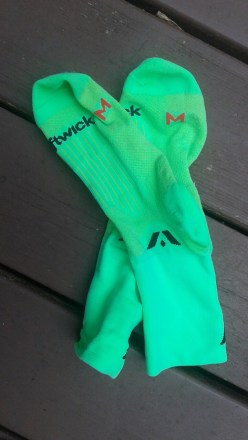
I was reminded of a simple example of joy when I started speeding down the hill just described, my feet were more comfortable in my new compression socks! Silly, I know, but also simple and joyful. The socks help message the calves, wick sweat away better and just add more overall comfort. And they were on sale to boot!

Like I said, it’s been a weird week, and I didn’t mention my CT scan (but that’s another story).

Bike Tipping and Humility

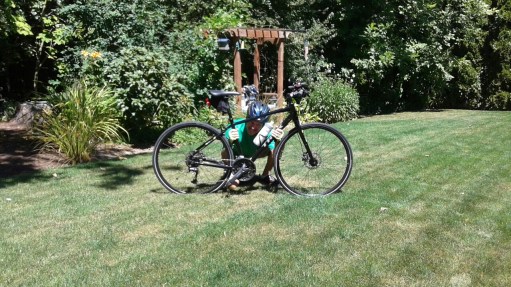
Bike cageOne of humanity’s most noble character traits is humility. This same character trait is sorely missing from much of our culture. Even Jesus “humbled Himself” (see Philippians 2:8). But somehow humility seems elusive. I was bluntly reminded of this just yesterday at a stop light.

I commuted to work yesterday on my bike, my brand new shiny hybrid Trek Allant 7.4. Yep, look at me commuting, reducing my carbon footprint and improving my fitness. Ha, I’m not in a metal box spewing emissions; nope, I’m using pedal power. (Forget the fact that I drive 99% of the time!)


Timmmmmbeeeerrrrr!

It all started at the last intersection before my building. I’m rolling up to a stale red light at Summer and Union streets. I’m looking at the light hoping it’ll turn green in the next nanosecond. Keep in mind that both of my feet are securely clipped tightly into the cleats on my pedals, and since they are still new, getting my feet out of the cleats quickly is difficult because they’re not broken in yet.

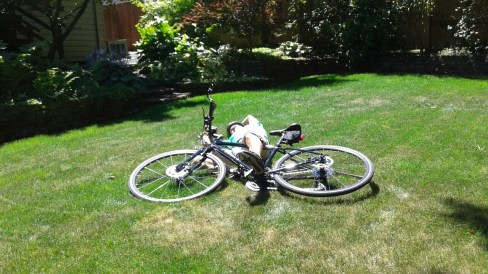
So my forward momentum is all but stopped. Suddenly I find myself desperately trying to uncleat. I’m jerking my right leg in vain efforts to get the cleat to, well, uncleat. Now my bike starts wobbling. But with no forward momentum along with the jerking of my right leg, my brand new shiny bike begins lurching sideways.

Oh yes, that old familiar feeling of losing balance came rushing back as the ground came rushing up. That nanosecond mentioned above was my inglorious tumble onto the curb (ouch!) and grass. And of course it was next to two buildings with a thousand occupants each along with a busy intersection. I’m sure those that saw it all happen thought the same thing as I did, “What an idiot!”

And I’m sure it was humorous. Funny how in mid-tip both of my feet just uncleated and Bike fall.jpgflayed out in different directions; looking somewhat like Charlie Brown when Lucy pulls the football away from him: limbs flailing followed by a big thud. The big thud was my right shoulder on the grass and my right knee on the concrete curb.

 

Okay, just get up and act like nothing happened

On top of all of these clumsy theatrics, I had to be at a meeting in less than ten minutes. And it was a meeting I was facilitating. So I couldn’t just lie there, I had to get up, get back on my bike, get to work and get the meeting started. So that’s what I did. As an old song lyric states, I got back up and brushed myself off and hopped back up on the saddle.

Well, the meeting was a great success and thankfully I didn’t show up bleeding. My bike received no dings and my knee is only slightly swollen today (I did eventually have to ice it.) And, most of all, my fused neck is still fused!


Holier than Thou…Not!

Honestly, I don’t perceive myself to be a creature of self-absorption. But I do have periodic run-ins what that little monster known as ego (aka pride). Even as I was supremely embarrassed by my little mishap yesterday, I find it quite humorous. But it also reminds me not to entertain attitudes of grandeur; what is often referred to as being haughty or conceited.

I am a new creation in Christ (2 Corinthians 5:17-21), that makes me cool in God’s eyes. But this “coolness” is purely because of God’s grace and mercy (Ephesians 2:1-10). Commuting on my bike doesn’t make me cool, neither does my attire or my paycheck. Christ makes me cool. At least to God I’m cool due to faith in Christ (Romans 10:9-10).

So the next time I start thinking I’m all that because I’m commuting, or have a cool bike or trendy new clothes, I’ll remember this bike tipping incident along with the embarrassment and my swollen knee. Hopefully this will help me thwart that little ego monster. But I do hope to remain upright!

The Atonement in Epic Haiku

Recently I had an assignment in my last theology class that was to be a creative project depicting the atonement. Well, I’m not a painter or sculptor, but I do like to write. So I chose to do what I am referring to as an Epic Haiku.

A Little Haiku History

Originally, what we know as haiku today were once known as hokku. These hokku were 17 syllables long in three lines with the following syllable-per line structure: 5-7-5. The hokku was part of a longer work known as a renga, with the hokku serving “as the most significant part of the renga[1] because it established the setting and season for the remaining work. Then the remaining work progressed through a series of what was in the Heian period (794-1185) known as haiku. The haiku of this era was 31-syllables with the per-line syllable structure of 5-7-5-7-7.

Through the centuries, luminaries such as Matsuo Busho (1644-94), Taniguchi Buson (1715-83) and Kobayashi Issa (1762-1826) morphed the literary art form of renga into what is now commonly referred to as haiku but their poems had the hokku structure. In other words, they were producing short poems in what we know in Western culture as the modern day haiku format. However, it was Masaoka Shiki (1867-1902) that actually first described haiku as an “independent three-line poem”[2]; the form that was originally referred to as hokku.

All of this to say that I have been writing our current understanding of haiku for years. I appreciate the art form because a properly constructed haiku can pack quit a punch in only seventeen syllables. One of the aspects I enjoy so much about haiku is the third line is usually a bit of a twist from the two preceding lines. For example, Shuoshi Mizuhara’s Solitude:

Closing gate

alone with the stones

on this beautiful night[3]

While the Japanese syllables do not align with our syllables, the point is the reader is thinking this is going to be sad because a gate is closing and the person is alone with stones. Instead, it ends with a person enjoying the solitude of the moment. In my treatment that follows, I tried to capture that third-line sense with an image that sets up the next stanza or leaves the reader concerned for what is coming next. I have also toyed with formatting in an attempt to direct the eye to either sweeping across the page or to plummeting down into the next stanza.


“Epic Haiku”

Another reason I like haiku is that, even though they look short and quick to compose, they can actually take a lot of time in working to capture just the right words in the correct syllable structure that properly captures the artist’s intent. But once complete, a well-constructed haiku can be easily memorized for later recall; not unlike memorizing Scripture.

All of this to say that I have taken a typically short Japanese art form and expanded it into a much longer one. My work is several haiku put together; hence, it is an epic haiku. Also, most haiku are about seasons, human emotions or something from an Eastern religion mind-set. I have taken the haiku, expanded it into an epic format, and turned its application to Jesus and His atonement. My prayer and hope is it brings joy and thankfulness to the reader, but I also hope and pray it brings a smile my Father’s face and honor to Jesus Christ.

[1] Tom Lowenstein, Haiku inspirations: Poems and meditations on nature and beauty. London: Duncan Baird Publishers, 2006, p. 8.

[2] Ibid., p. 9.

[3] Quoted from Patricia Donegan, Haiku mind: 108 poems to cultivate awareness & open your heart. Boston: Shambhala, 2010, p. 151.

Atonement

The Journey of the Atonement in Epic Haiku


In the beginning

all was well in the Garden.

Walking, talking and tilling.


The trees were nice there,

especially Knowledge tree!

We could look – not eat.


Temptation and lies

enticing to disobey.

“Come quick, let us…….hide!”


Our hearts darkening,

serpent slithers silently.

Emptiness inside.


Coolness of evening,

Footsteps on the Garden path,

“Come now, where are you?”


 Talking, blame, banished;

  It all ended suddenly.

   Flaming swords, closed gate.


Heel to head doom,

humanity wandering.

Redeemer coming.


Years and years and years.

Temporary sacrifice;

still distant from God.


Justice demanded,

necessary sacrifice.

The once and for all.


The Word became flesh;

Son of Man sent from Heaven—

dwelling among us.


Sinless, righteous power.

Fully God and Fully man

the deliverer.


Healing, releasing,

even nature obeys Him.

But…then scorned and scourged.


Crucified for sin,

replacing mankind on the cross;

paying debt in full.


Breathing His last breath—

then darkness upon the earth.

Had sin, Satan—won?


Third day, morning light.

Stone rolled away, men in white,

“Not here, He’s risen!”


Then appearing, “Peace.”

The redeeming Messiah.

Savior of the world!


Standing in our place,

completely paying the price—

bridging the chasm.


Born from above,

God and man reunited—

And…it is finished!

Who Needs Salvation?

crossing the chasm

We all need salvation. Scripture says so. I explored this a little bit in my Killing Shalom post. In that post I share Scripture that leads people into the new birth through faith in Jesus Christ. What I didn’t explore in a lot of detail was why we need a savior in the first place.


Adam and Me

Simply stated, Adam and Eve were the first created human beings. When they willingly sinned, they introduced a sin nature into the fabric of their psyche. This sin nature then became ingrained into their DNA; and by default, it is ingrained into our DNA as well. (See my post on Image for a little more background on this.)

When they intentionally sinned, they tarnished humanity’s desire to seek after God. This tarnishing built into them the desire to seek fulfillment outside of God. It also led them into a type of pride where they fancied they could become like God. This is the same sin the got Lucifer booted out of Heaven.


Sin Nature and Depravity

Because of the tarnishing of this aspect of God’s image, we now have hard-wired into the fabric of our being a sin nature; that is, an intentional, ongoing rebellion against God. Humanity is now depraved in the sense that while humanity for the most part is not as wicked as it could be, humanity is still utterly incapable of reversing this stain of sin without an intermediary

This sin nature has been passed down through the generations (see Romans 3:21-26 and 1 Corinthians 15:21-22). This is why Radmacher says that “because the human race is ‘in Adam,’ everyone is spiritually dead, and, if this is not corrected, the ultimate result is eternal death” (Salvation, 2000, p. 7).

None of us escape this sin nature and this natural separation from God. The only way to span the chasm between God and man is by faith in Jesus Christ.


Mind the Gap—Spanning the Chasm

Thankfully, Jesus spanned this chasm by tearing down the wall of separation between humanity and God. Scripture states that at the death of Jesus, God tore the temple veil from top to bottom (see Matthew 27:51-54, Mark 15:33-39 and Hebrews 10:19-20). It is symbolically significant that the veil is torn from the top down. If I tore the veil, which is really a heavy curtain or a tapestry, I’d tear it from the bottom up; provided I had the strength to tear it all. However, such a tear would be, obviously, man-made and therefore insufficient. Being torn from the top down, however, indicates it is God doing the tearing of the veil. It is God that is opening up access to Himself through the accomplished works of Jesus Christ. We no longer need a priestly intermediary, we now, by faith in Christ, have direct access to God. Jesus is now our High Priest (see Hebrews 4:15).


No Prerequisite but One

And entering into a salvation relationship is by simply placing our faith in Him. It has nothing to do with our politics, our lifestyle, our hobbies or interests; it is on the basis of our faith in Christ: do we, or do we not, believe on the Lord Jesus Christ? Romans 10:9-10 is very clear:

That if you confess with your mouth the Lord Jesus and believe in your heart that God has raised Him from the dead, you will be saved.

Notice how there are no rules, no sprucing ourselves up or other hoops to jump through; God is saying come as we are and enter into His saving grace through faith in Christ. A sincere heart genuinely seeking salvation in Jesus is welcomed with open arms. Once a person receives salvation, they now have the Holy Spirit dwelling in them. The Holy Spirit can now transform their lives, becoming more and more like Christ! Godly fruit can now be produced in a person’s life in such a way that God’s light and love now shines to those around them, drawing even  more out of the darkness of sin and into the light of God’s saving grace.

So what are you waitin’ for? C’mon in!

Tissues of Praise?

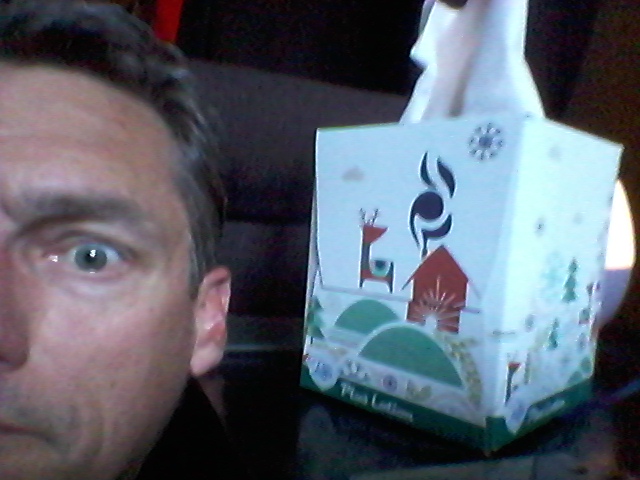
Tissue_Box

I feel crummy. No, not crumby like I’m shoving fistfuls of saltines in my mouth. Crummy as in miserable, as in puny, as in…sick. Yep, sick. I can’t tell if it’s a summer cold or monster allergies or a combo platter of both. What I do know is I’ve gone through boxes of tissues. And when I ran out, I used paper towels (which I highly DON’T recommend!).


Missed Meetings and Canceled Dinners

I’ve missed two days of work containing six different meetings. I’ve missed two important and exciting church meetings (yes, I do find them exciting—weird, I know). I missed my oldest son’s band’s Friday night concert. We canceled a small dinner party for tonight and I have to reschedule an invite to the shooting range. And I’ll probably miss church.

I know…waaaahhhh! Still, I’m frustrated. I carefully planned my schedule, color-coded my appointments on my Franklin Planner and set alarms on my cell phone. But all for naught. I fear people are disappointed in me or think I’m wuss. I eat tons of raw fruits and veggies, exercise, get moderate rest; I live a healthy lifestyle. What’s going on?


Who Really Holds Tomorrow?

Part of what’s going on is realizing that healthy living is not to become a prideful badge of honor. I’m still in a broken body in a broken world and am susceptible to whatever crud is going around. When I don’t get the crud, I ought not to be praising myself for my healthy living, but instead praising God for sparing me from the crud. When I get the crud, as I have now, I need to praise God that He allows me to draw breath at all—especially since much of my past hasn’t been filled in glorifying Him. Mercy and praise should be my thoughts even as I again empty my schnoz into yet another tissue that frays on my whiskers.

Moreover, God doesn’t promise me tomorrow—He promises me an eternal destiny forevermore with Him. My tomorrow could be in Heaven. Or it could be another day of sniffles and fraying tissues. Or healing.

And in spite of all my planning, color-coding and alarm-setting; God is the one holding tomorrow:

Come now, you who say, “Today or tomorrow we will go to such and such a city, spend a year there, buy and sell, and make a profit”; whereas you do not know what will happen tomorrow. For what is your life? It is even a vapor that appears for a little time and then vanishes away. Instead you ought to say, “If the Lord wills, we shall live and do this or that.”

–James 4:13-15

Plan On…But Pray First

So James does not discourage planning, but he does remind us to remain mindful that God is ultimately in control of all things and does indeed hold our lives in His hands. Planning is good; prayerful planning is even better. Humility then, may be the catalyst for authentic prayerful planning.

So while I’m bummed my schedule has been so severely impacted and I’m equally as bummed to be feeling crummy, I am grateful for the reminder that no matter what my plans or my healthful lifestyle are, God is the One that is central to my life and being. Keeping this in view will allow me to live more freely in the Lord and, frankly, have more grace to others when they can’t show up to meetings or have to cancel dinner plans.

Next week I’ll return to themes more theological, but for now—I’m out; gotta go blow my nose!

Killing Shalom


I believe sin is the willful disregard for the things of God. It includes the intentional denial of God’s existence, the intentional disobedience to the commandments of God, pride, and placing anything above God (such as self, money, family, fame, status, etc.) As we explored last week, sin actually originated in Heaven. What’s more, we are all sinners but Jesus is our antidote to sin:

For there is no difference; for all have sinned and fall short of the glory of God, being justified freely by His grace through the redemption that is in Christ Jesus, whom God set forth as a propitiation [atonement, payment] by His blood, through faith. (Romans 3:22-25, NKJV).

But how else can we define sin?  Plantinga states that, “in short, sin is culpable shalom-breaking”[1]. Additionally he states that “sin is blamable vandalism” against God’s design of shalom and is thereby “an affront to their architect and builder”[2]. These quotes help me begin to ponder a wider definition of sin, but they are incomplete without Plantinga’s definition of shalom which “means universal flourishing, wholeness, and delight—a rich state of affairs in which natural needs are satisfied and natural gifts naturally employed”[3] (emphasis in the original). Sin, as Plantinga presents it, is a willful or intentional thought or act that somehow disrupts someone’s or something’s flourishing. This is somewhat of a flimsy summary without a concrete, though somewhat minor, example.

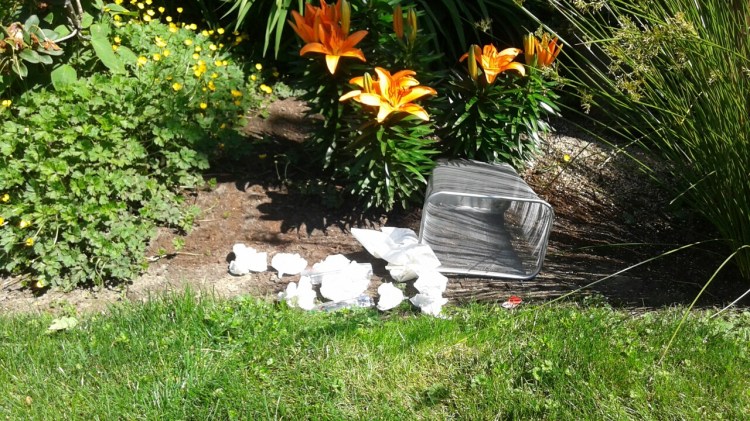
Trash_pic

This is a simple illustration of something we have all seen, and quite possibly have done: litter. If I litter, something like throwing trash onto a beautiful landscape, I’ve now willfully disturbed nature by introducing a man-made artifact into the natural beauty. I have littered; I have juxtaposed God’s creative beauty with my personal refuse. I have opened the door to an animal or bird mistakenly eating a littered item and possibly getting sick or dying because of it. I have also marred the aesthetic beauty of the area, thus diminishing another person’s joy of what could have otherwise been a peaceful spot of solitude and praise toward God.

I have disrupted the shalom of an otherwise pristine beauty. This blemish now retards the flourishing of both the natural realm and the relationship to other humans because they now to have to endure this blemish. This other person may be the one to fix the blemish in an attempt to restore the area to its near natural state. How do they do this? By picking up the ugly trash I left behind. Once they pick it up, they have to properly dispose of it. This person is now not only enduring the blemish, but is now having their time impacted due to fixing someone else’s vandalism.

I realize this example does not rise to the same level as adultery or murder, but it is a subtle and important, though not readily recognizable, example of shalom disturbance. It illustrates the tarnished interior of the functional aspect of the image of God discussed last week. It is the insidious nature of sin working in simple areas of our lives where we willfully disturb shalom. As this willfulness grows, it expands into greater expressions of shalom-disturbing acts. So take this simple example of littering into other areas where we begin willfully harming humanity.  If littering is shalom disturbance, thus sin; then how much more of a “shalom disturbance” are the easier to recognize sins such as lying, rape and murder?

But lest we lose hope, this flawed aspect of our image of God can begin to be rehabilitated through Jesus Christ:

“Behold! The Lamb of God who takes away the sin of the world!” (John 1:29.)

Christ died for our sins. (1 Corinthians 15:3.)

“Repent, and let every one of you be baptized in the name of Jesus Christ for the remission of sins; and you shall receive the gift of the Holy Spirit.” (Acts 2:38.)

[1] Cornelius Plantinga, Jr Cornelius Plantinga, Jr., Not the Way it’s Supposed to Be: A breviary of sin (Grand Rapids: Wm. B. Eerdmans Publishing Co., 1995), p. 13.

[2] Ibid., p. 16.

[3] Ibid., p. 10.


Image

Image_2

What is my image? Is it what I portray on social media via my computer? Is it what the mirror reflects? Is it what other’s think of me? Hmmm.


In God’s Image

Scripture states that God created humanity “in His own image” (Genesis 1:27; see also Genesis 9:6 and James 3:9). But what does this mean?

When I was a freshman at the great institution of conservatism known as the University of Oregon, I thought that maybe the image started as an ape, thinking I could marry creation and evolution. It didn’t take too long to realize this was wrong-headed. But I still had no answer.

Erickson states that “the biblical picture of humanity’s origin is that an all-wise, all-powerful, and good God created the human race to love and serve him, and to enjoy a relationship with him” (Christian Theology, 2013, p. 439). I don’t dispute this, but I’m still unsure about the image of God in humanity.


Two Aspects

Anthony Hoekema concludes that God’s image in humanity has two aspects: what humanity is and what humanity does. What humanity is can be called the structural aspect and what humanity does can be called the functional aspect.

The structural aspect relates to “the entire endowment of gifts and capacities that enable man to function as he should in his various relationships and callings” (Created in God’s Image, 1986, pp. 70-71). And the functional aspect is how humanity engages in life, whether that is engagement with other humans, or with the environment or with God. Thus, returning to Hoekema, the functional aspect means humanity’s “proper functioning in harmony with God’s will” (p. 72, emphasis mine). So the structural aspect means we were originally built to function properly and the functional aspect is do we actually choose to function properly. This makes sense to me, but let’s see if I can illustrate this a little differently.

server_room.jpg

Servers and Metaphors

Metaphorically, it helps me to think of this like a large building. The building is more than a foundation with concrete and rebar. It has interior rooms with specific functions in mind (e.g., conference rooms, single-person offices, reception area, cafeteria, large areas for cubicles, etc.). It has wiring for all different types of technology, and it has heating, ventilation, and air-conditioning (HVAC) equipment. All of this comprises the structure of the building. Often, the technology is centralized in a “cool room,” or as in my workplace it is called the ‘server room,’ where all wires originate and where many servers are in place and are ready to handle the computing needs of the building’s occupants. Similarly, much of the other physical attributes, central HVAC and plumbing equipment are often housed in an area known as a physical plant or utilities areas. These are all representations of endowments bestowed by God into the structure of the human.

Thus, in the same metaphor, the functional aspect means our building’s operations. Does the HVAC respond properly, or does cool air come on when the controls are set for heat? Does the plumbing work when faucets are turned on or do they leak, spray, or clog up? Is all of the technology working properly or are there computer crashes and power fades? In other words, are the building’s functions operating in harmony with the wishes of the building’s architects or are they malfunctioning?

Herein is the pertinent difference between the structural and functional aspects of God’s image in humanity. When humanity fell into sin as explained in Genesis 3:1-7, humanity still retained the image of God in the structural sense but lost it in the functional sense. Why is this? Because humanity willfully stopped functioning in harmony with God’s will. In a malfunctioning building, the structure itself remains intact, but the inner functionality, the functional aspects of building operations, are in disharmony.


Conclusion

So while humanity still retains the image of God, it is tarnished, damaged and in need of rescuing. The reason is because humanity has willingly chosen to depart from the original design of its Architect. But why do we need rescuing and how do we get rescued? And what are we rescued from? Well, those are other posts!

Please stay tuned…

By the way, I’m posting a day early because I’m going on a fishing trip with my youngest and Grandpa!

The Gift of Marcus

The news came pouring through the phone early that Christmas Eve morning. In sobbing bursts Diana cried the news to Janey, “Marcus was killed last night in a car wreck!”

“What!?” said Janey incredulously. “How could this be?”

But it was true. Our dear friends in Omaha lost their 20-year-old son in a one car accident. Authorities said he died at impact so there was no pain; he was here then he was gone. Gone! As a father it’s mind-numbing news. Thankfully, Marcus was a young man solid in his Christian faith; and while we know that Marcus is experiencing inexpressible joy, we still sorrow—and we remember.

I have great memories of them as our neighbors. How the boys, Marcus, their oldest son, and Ben, my oldest son, would play baseball in the cul-de-sac. They’d see who could hit the ball all the way to the main street or make the coolest sliding-from-the-knees-catches in our front yards. I remember all those Little League games—the winning, the losing—and the fun! I remember those darkening spring evenings cheering the boys on. I remember the sleep-overs, the bickering, and the laughing. Oh those were good times!

The last time I saw Marcus was when he came from Omaha to visit us in Keizer. Marcus, Ben and I drove up to Seattle to see a couple of Mariners games. Chris, Marcus’ dad, scored great tickets right behind the Oakland A’s dugout. It was so cool, we could hear some of the players’ conversations and I got to sit and listen to Ben and Marcus debate various strategies. We even saw one of those rare triple-plays!

Now Marcus is gone and I cry out to God, “now what?” Well, here’s my sense of God’s answer to my cry. Marcus was a life lived well. He left with no emotional wreckage in his wake. He left with family and friends knowing he loved them. He left with a good plan for his future. He left already having led several young people to life in Christ. And he’s left us with a great legacy because of a life lived well.

Legacy Left

Yes, his life was brief. And even as our souls are saturated in sorrow now, our tears will dry and we will carry on with our lives. Even so, we can still rejoice in the fact that he is with Jesus forevermore! We can celebrate the life he lived among us. We can cherish the memories he leaves. And we can be inspired by his legacy, may our lives become lives lived as well as his.

Thank you, Lord, for the gift of Marcus; yes, we sorrow now, but in time his memory will live on via a living legacy of a life lived well, of a life lived for Jesus Christ; and we know that one day, we will see Marcus again!