A Long Road

Where to begin. How about early 2018, that’s the last time I posted a blog. That January I started my Doctorate program, had a panic attack and started physical therapy. Later that autumn I began a stint as an adjunct theology professor, lasting four years all while working fulltime at my “day job.” 

Mid-2019 began what turned into five years of significant health battles. I had two life-saving surgeries, three different hospital stays, a mysterious illness, and one ambulance ride (more on these in later posts). 

But I was still working, still in grad school and still writing. Only I wasn’t writing blog posts. Instead, I was writing research papers, lesson plans, and a dissertation. But now my Doctorate Degree is finished and my run as an adjunct professor is completed. I now have time for more personal writing where I can explore new ideas, diverse genres, and different topics. Through these years, however, I have developed a whole new perspective on life, on suffering, and on what really matters.  

The difficulties of the past years are what is informing my writing and, frankly, my purpose. I’ve learned a lot through this time. Much has come from books and research of course, but even more through my journey of suffering, through the love of others, and through the challenges to my faith.  

I now know that my calling is “to equip the saints” and to show “that God’s kindness is meant to lead people to repentance” (Ephesians 4:12 & Romans 2:4 ESV). My goal is to be an inspiration to others; when times get rough don’t give up, don’t give in. Keep fighting the good fight. Darkness may encroach, but the light is coming. I know, I’ve lived it. And in the end, its relationships, listening, learning, teaching, and just being that are all part of the sweet spot of life. 

Relationships & The Common Denominator 

“I made known to them Your name, and I will continue to make it known, that the love with which you have loved me may be in them, and I in them.”

-Jesus, John 17:26

True and lasting relationships have love as the common denominator. The love of a husband and wife, parent and child, and close friends. The love of a Savior. “Love is patient, kind…and never ends” (1 Corinthians 13:4 & 8). Love holds your hand when in you’re in pain. Love sits next to you in the Emergency Room as the doctor frowns over the images. Love visits without being asked. Love endures. Love inspires. 

Listening Well

“Most people do not listen with the intent to understand; they listen with the intent to reply.”
—Stephen R. Covey 

Listening well helps us to understand deeply. It helps us hear the cry behind the complaint, the feelings behind the flippancy, and the plea behind the patronizing. A good listener can unlock the heart of a silent sufferer, opening a space for more than dialog, a space that has meaning. A good listener can help make sense of the nonsensical and help get the derailed train of thought back on the track. A good listener can help move a mountain in your soul and remove the log from your eye, helping you to see the truth more clearly.  

Learning & Teaching

“Learn from Me, for I am gentle and lowly in heart, and you will find rest for your souls.”

-Jesus, Matthew 11:29

Learning is a life-long endeavor. When we quit learning, we quit growing. When we quit growing, we quite living. Be curious. Ask questions. Teach others to help them learn. Then let them teach you. 

Being & The Ever-Present Now

Slow down. What’s the hurry? The work will be there tomorrow, but the moment at hand will never be here again. Be present. Forget tomorrow, focusing instead on the now. The now is all we have. The past is done and the future is fluid, but the now is where the relationships are forged, hearts are touched, and lives are changed. The now is also when lives end. I thought about that while lying in the back of an ambulance. I was praying that I’d have more “nows,” but at that moment, I didn’t know if I would. 

What’s Next

I’m back to writing. I have a children’s book called Carson’s Recovery available at Amazon. It is published through Alonili Press, an emerging, independent publisher being built by a small group of writers.  I have another short story called Freedom Ride coming out later this year. And I’m finishing a larger, non-fiction work on how our union with Christ can help ease our anxiety. It’s tentatively called Anxiety, Me, and the Peace of Christ. I intend to continue blogging regularly. My topics will be varied, but will include some theological posts, some whimsy, and some cycling stuff. Maybe some guest posts if anyone’s interested. If so, please let me know. 

I hope to inform, inspire, and entertain. But only you can tell me if I’m successful at that.

May the Lord smile upon you. See you again soon (Lord willing). 

A Discussion of Time

Time“Does anybody really know what time it is?” asked the rock band Chicago back in 1969 (from their debut album Chicago Transit Authority). I am also asking the question because invariably, my perception of time is drastically different on the weekends than it is during the work week. C. S. Lewis said of time that, “Humans live in time … therefore … attend chiefly to two things, to eternity itself and to … the Present” (The Screwtape Letters, pp. 67-68). Maybe my perception changes because my “present” changes.

Still, usually, time doesn’t really seem to be my friend. When I have plenty of it, I lose track of it; like on Sunday mornings when I’m always late for church (thusly, my entire family is late as well). When I don’t have enough time, I become task and outcome-oriented, more focused on accomplishments than relationships.

Barry Parker, in his biography on Albert Einstein, wrote, “If you asked several people what exactly is time, you would no doubt get a different answer from each of them. And the truth is: nobody really knows. It’s easy enough to point to your watch and say, ‘It’s what that thing is measuring.’ But does that really tell us anything? No, it doesn’t, and even if you quizzed scientists, they would admit that they don’t understand time any better than anyone else” (Albert Einstein’s Vision: Remarkable discoveries that shaped modern science, pp. 101-102).

Time seems both easily discernible and mysteriously elusive. Scripture says that “to everything there is a season, a time for every purpose under heaven” (Ecclesiastes 3:1). Genesis states that, “God called the light Day and the darkness He called Night. So the evening and the morning were the first day” (1:5). Interestingly, the concept of day and night is defined early in the creation account, even though the sun and moon don’t come onto the scene until verse 16. This also clearly indicates that God is not bound at all by time. In fact, as I stated a few blogs ago, He created it.

But it is in this context that we define time. That is, we define time based on divisions of what we call a “day.” A typical day is 24 hours and we divide that 24 hours up into 1-hour increments. So much of our lives are based within this framework of 24 hours, of which around eight of those hours are spent in or around sleeping. And we can get even more technical and explore how sunlight affects our differentiating of time.

But really, is life based off of minutes and hours or is it based more off of experiences and outcomes? For instance, our accepting of Jesus Christ as our Lord and Savior occurs in a segment of time; but is the segment what’s important or is what happened in that segment important? I know that’s a rhetorical question, but it sort of gets at the heart of things. A project is due to be completed by x-date; but why and who said it? Is the date based on some other set of issues or on an arbitrary selection in the attempt to get things started? Do people lose their lives if deadline is missed? Or, more likely, will a new deadline be established?

Bottom line is, we live in a structured environment that is highly regulated by our perception and application of time. But isn’t it interesting that many cultures around the world are not as bound by time as we are? Did Jesus wear a watch? Did the Apostles have deadlines and quotas to fill by certain times? Well, no, they didn’t. But we sure do.

Now please don’t get me wrong, we have bosses that tell us when to be at work and when we can go home. We have discipleship groups, youth groups, and church gatherings that all start at certain times, and we invite our dinner guests to show up at specified times. So, yes, time and time-setting are important; they keep us organized and they assist in setting and meeting expectations. But somehow, we need to have more unstructured “times” in our lives when we can just be rather than do. That’s why my perception of time changes on the weekends; I am shifting from a doing-orientation to a being-orientation.

I hope that makes sense. Now it’s time to make dinner.

The Maze of Numbers and Milestones


Maze

Pumpkin Patch maze near Jefferson, Oregon.

“Age is just a number,” she said. This was from a school official in a meeting a few months ago about our youngest son. It was a tough meeting, one of the toughest I’ve been through as a parent.


When I was a kid, parent-teacher conferences weren’t that big of a deal. Sure, I got in trouble here and there for being a class clown, but I always managed to earn good grades. But somehow, somewhere, things changed on my way to being a father. Now the conferences are more serious and intense. There’s a lot more tests and man-made standards kids must achieve.

At this meeting we had to consider making a very difficult decision. The decision would cause delays in typical age-related milestones, to which the quote above was about.

Since then I’ve been thinking. Who came up with age-related milestones in the first place? What’s so special about 18, 21, 30, 50 and so on? I don’t even see that it’s biblical.

For instance, Abraham and Moses were in what today’s society considers retirement ages. Daniel, Timothy and especially Mary were in what today’s society considers the younger, or more immature years. And we don’t know how old Paul or the first disciples were. And check this out:

Beloved, do not forget this one thing, that with the Lord one day is as a thousand years and a thousand years as one day.
—2 Peter 3:8

God is above time, He is not bound by time; he created time (see Genesis 1:3-25). And God will accomplish His work regardless of time. He will accomplish His work in spite of us and He will accomplish His work through us, regardless of our age.

My point is that perhaps age is nothing but a number. Maybe I’m too hung up on age. Maybe expecting my kids to accomplish “x” by age “x” is unrealistic and maybe even ungodly. Maybe I shouldn’t put the same pressure on myself either.

Case in point, in my late twenties I went back to graduate school to work on a Master’s Degree. My goal was to have it finished by the time I was 32. This was before the internet caught on, so classes were brick and mortar classes. I’d drive up to Portland once or twice a week for three-hour evening classes. At this rate, it’d take three years to complete. But I was single, and I had the time (and money) to pull it off. Except I didn’t consider actions the school would take.

What happened is other state schools closed their communications departments and sent these students to Portland State University where the Master’s program was. To accommodate the large influx of new students, the school changed much of the curricula to more traditional offerings. That is, once-a-week evening classes were now going to be offered three times a week in the mornings. This meant that for me to continue I had to either quit my career, which was beginning to really take off, or quit school because I couldn’t attend classes during working hours.

I chose to stay with my career; and that was a great choice, my career has been rewarding, fun and I’ve met and worked with so many great people over these many years.

Another interesting thing, though, is as technology changed, so did God’s leading in my life. This led me to eventually return to graduate school utilizing new, online technologies. And I did finally complete a Mater’s at 54; only it was 22 years past my original age-related goal.

However, the significant shift came in the subject matter: I was originally pursuing a degree in Organizational Communication, but my actual degree is in Christian Leadership and Teaching. My previous studies have come in handy from time to time, but that’s not the subject area of my passion; Jesus is. Had I stayed the course all those years back, I may have missed God’s real call on my life and now be a miserable wreck.

So maybe she was right, maybe age is nothing but a number. Maybe most of my age-related goals are nothing but numbers; and numbers are subject to change and so is our sense of God’s work in our lives.


“Anxious for nothing…,” Seriously?!

Over the years, I’ve heard many people say either from the pulpit or in conversation that worrying is a sin. The word ‘sin’ in and of itself, simply means missing the mark; as in an archer missing the bullseye with the arrow shot from his bow. Theologically, it can be rendered as intentional behavior that is outside the will of God (that’s my definition, anyway). Worrying, or anxiety, the word used in Philippians 4:6, is defined as “anxious care” (Wuest), or “disquieting perplexing care … and distracting thought in the wants and difficulties of life” (Henry), or to have “anxious or distracting care” (Bullinger).

Any of these definitions work for me, especially the distracting part. In fact, for professional worriers, distracting could also be obsessing.  Descartes is credited with saying, “I think, therefore I am.” Somewhere in the long line of my lineage, some wannabe philosopher changed this a bit to say, “I think, therefore I worry.” Worrying is one of the primary threads sewn throughout the tapestry of my heritage. I’ve successfully taken distracting care into obsessing care; so much so that I’ve nearly suffered from panic attacks involving hyperventilating with a strong sense of paralysis. Maybe you can relate.

Worrying has taken a toll on my health and on my relationships. And now I’m being told that it’s a sin to boot. Now I’m worried about that.

But how do I stop? Well, let’s read Philippians 4:6-7 and then I’ll explain what I’m discovering works for me.

Be anxious for nothing, but in everything by prayer and supplication, with thanksgiving, let your requests be made known to God; and the peace of God, which surpasses all understanding, will guard your hearts and minds through Christ Jesus.

As McGee points out, this passage starts with anxiety and ends with peace. But notice what’s in the middle—prayer. It’s interesting to note that the mood of the passage is present, active, imperative; this means that it is akin to a command and that it is an ever-present command. It’s not just a command to stop worrying, but it is also an ever-present antidote to the worrying. In other words, anxiety is always crouching and waiting to pounce on us; whether at work, or home or school or with the doctor, anxiety is an ever-present reality in this life of ours. But so is the antidote, prayer.


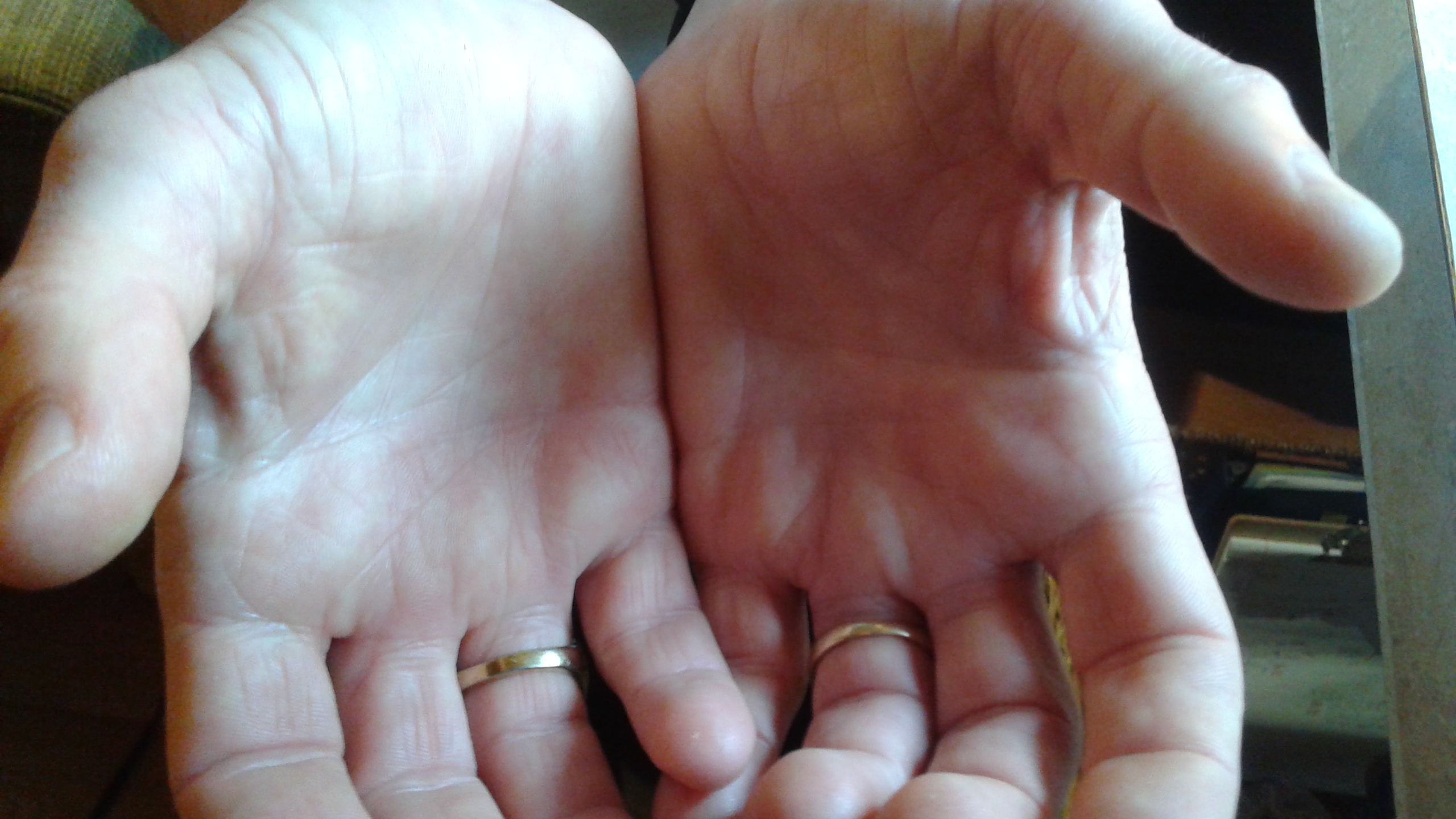
Hands

Yeah, they’re my hands, but you get the point!

When we feel anxious, Scripture encourages us to specifically pray about our anxiety and ask for God’s help with it (this is basically the essence of the word ‘supplication’). And we do so with thanksgiving; we’re thankful that God not only willingly listens to our prayer, He actually invites us to pray about it; He welcomes it into His presence. Think of it as an always open invitation from God to lift our cares, concerns, and worries up to Him.  I often think of placing the anxiety, whatever form it’s in, into His hands; then I pray that God will empower me to leave it there; to leave this anxiety in His hands and thereby lift it off of my shoulders and out of my guts and into His always open hands.


But just how is this operationalized; how is this put into action in everyday situations? It’s taken me years to figure this out, and I am not 100% anxiety-free by any stretch of the imagination; but here’s what I’ve been learning lately.

As we just explored, this passage of Scripture is active, present, imperative. Yeah, yeah, techy-speak, but what it means is that I can recite this section of Scripture as a prayer as often as I need to. And that’s what I’ve been doing lately. When the anxiousness begins threatening me again, I lift the anxious thinking and the specific situation with a specific request to God. Rarely does the situation change, but my internal well-being changes. Slowly, and somewhat strangely, I start sensing God’s peace. I can’t really explain it, and perhaps that’s part of why God’s peace “surpasses understanding;” but the sense of peace is very real and has staying power. My thoughts become freer, I’m able to focus on the present more clearly and my heart slows its palpitations. This calmer state then enables the guarding of my heart and mind through Christ Jesus. This means that when I’m not distracted or filled with anxious thoughts, I am more capable through the indwelling Holy Spirit to keep more anxiety out of my thinking. The stronghold of worry in my life is slowly being uprooted as I spend more time in God’s peace through the ongoing prayer of supplication with thanksgiving.

But now back to the sin part. I don’t think my propensity toward worry or anxiety is sinful; what I think is sinful is refusing to acknowledge it as contrary to God’s will for my life and the subsequent refusal to partake of God’s antidote for it, prayer. But as I become more adept at recognizing the anxiety and quicker to lift it up to God in prayer, the less likely my propensity will turn to sin, and the happier and healthier my life will become.

Integrity and Proverbs 10

Integrity

Proverbs 10:9 states that “He who walks with integrity walks securely, but he who perverts his ways will become known.” Integrity is defined as “completeness, innocence, uprightness”[1]. I highly value being a man of integrity and strive to maintain it as best I can. Over time, however, I have made mistakes and my integrity has taken a bit of hit; especially if I have said or done something stupid while trying to represent Christ! But part of understanding integrity is recognizing when you’ve tarnished your own; you learn what not to do again or how to do or say things differently in the future. I also highly respect other men of integrity, they are a great example to me and a great help for me in making big decisions.

A key value of integrity contained in the proverb is we can walk securely; as we live a life with integrity, we know that we have nothing to hide and that we keep our word. Others begin to trust us so we need to value the trust they have in us and not compromise it through foolish actions or words.

Keys to Integrity

Keys to understanding, building and maintaining integrity include continually opening our lives up to Holy Spirit examination. Through this we need to do our best to hear and obey when He, the Holy Spirit, reveals weaknesses or barriers inhibiting a freer flowing of Him in our lives (cf. Ps. 139:23-24). Another key is spending time in God’s Word; the more Scripture we know the more equipped we are to live a life marked by integrity, especially as we study the life of Jesus. Hanging around those with high integrity is also a good idea, we can learn a lot through how they live their lives, especially when they are in difficult circumstances. This leads us to add two more aspects to integrity: humility and obedience.

Lacking integrity reveals a person that is two-faced and unstable (cf. Ja. 1:7). This person cannot be trusted with the things of men or of God. Such a person also lacks the humility to recognize their error, which can open them up to very serious calamities. This causes us to ponder if the lack of integrity means a strong presence of pride.  We will explore this possibility in a later post on Proverbs devotionals.

Practical Steps

Now more than ever integrity is eroding in our culture at rapid rates. Politician don’t mean what they say, entertainment is becoming more and more dehumanizing and sexualized, and the individual is quickly replacing the sense of community. One way to help stem the tide of such erosion is becoming a person of integrity: say what we mean, keep our promises, help others when we have opportunity, and lean more deeply into the things of God.

[1] Strong’s Concordance, pp. 136 & 555.